The 10-Business-Day Do-Not-Call Window: What the Hilton Ruling Means for Calling Teams
By EasyDNC ·
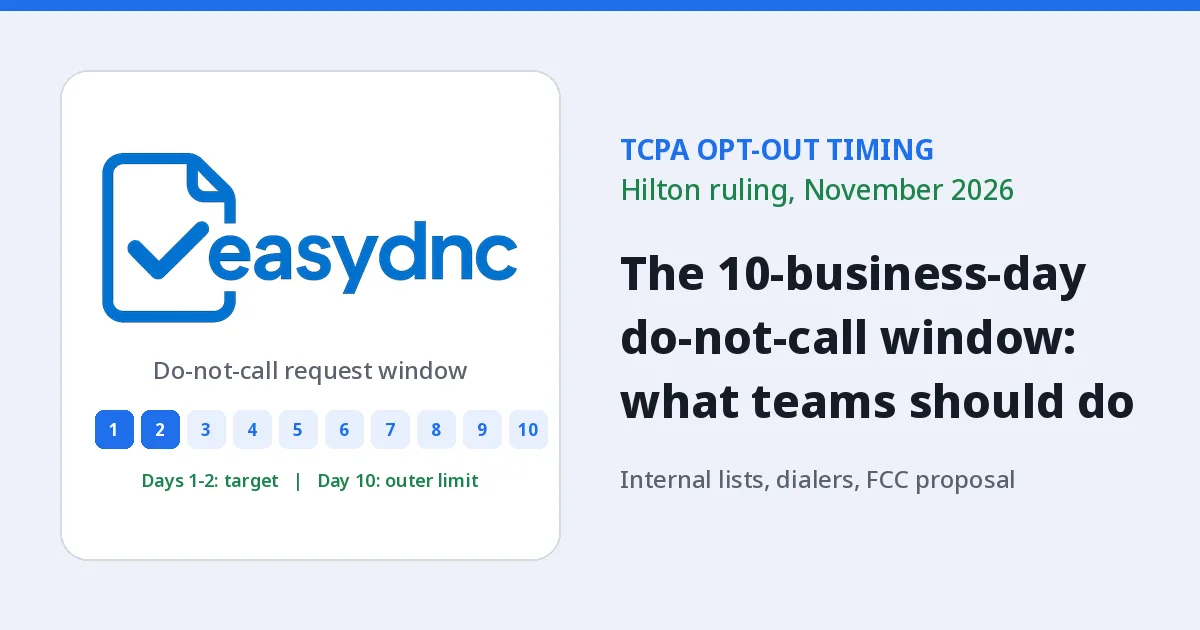
On November 10, 2026, a federal court in Washington dismissed a proposed class action against Hilton Grand Vacations. The plaintiff had asked the company to stop calling, then received 13 more telemarketing calls over the next two weeks. Every one of those calls landed inside the ten-business-day window that FCC rules allow for honoring a do-not-call request, and the court held that was enough to defeat the claim.
The ruling arrives in a busy week for opt-out rules. The FCC's revised consent revocation rules take effect on November 25, and comments are due the same day on a Commission proposal that asks whether the ten-day deadline for revocations should shrink to seven business days. For teams that run outbound campaigns, all three developments point at the same file: the internal do-not-call list that sits beside every registry scrub.
This article explains what the court decided, what the FCC is considering, and how calling teams and agencies can set up do-not-call request processing that does not depend on using the full ten days.
Teams that scrub lists with EasyDNC can upload a file from the EasyDNC home page, check a single number with the Free Test Lookup, or connect a dialer through the EasyDNC API.
What the Hilton Ruling Decided
In Plenty v. Hilton Resorts Corp., No. 2:26-CV-00258-SAB (E.D. Wash.), the plaintiff said she asked the company to stop calling on February 10, 2026. She alleged 13 more marketing calls between February 11 and February 25. The court counted ten business days from her request and found the period ended on February 25, the date of the last call.
The plaintiff did not dispute that timing. She argued instead that a large company could have honored her request almost immediately, so calling until the deadline was not a "reasonable time." Chief Judge Stanley Bastian declined to add a separate reasonableness inquiry for calls made inside the ten-business-day period. He noted that the plaintiff cited no binding authority for that reading and dismissed the complaint with prejudice.
The order is a single district court decision. It does not bind other courts, and a different judge could read the "reasonable time" language differently.
The Rule Behind the Ten Days
The deadline comes from 47 CFR 64.1200(d)(3). It requires a business making telemarketing calls to record a residential subscriber's do-not-call request and place the number on its do-not-call list at the time the request is made. The request must then be honored within a reasonable time, which may not exceed ten business days from receipt.
Two other parts of the same rule matter for teams that work through vendors. If someone other than the seller records or maintains the requests, the seller on whose behalf the calls are made is liable for failures to honor them. Under 64.1200(d)(6), a do-not-call request must be honored for five years from the time it is made.
The FTC's Telemarketing Sales Rule has its own entity-specific do-not-call provision. It prohibits calling a person who has said they do not want calls from that seller, and it does not repeat the FCC's ten-business-day wording. Its safe harbor rests on written procedures, trained staff, a maintained list, and a process that keeps calls away from listed numbers.
A Separate Clock Is Under Review
A second ten-day clock applies when a consumer revokes consent to robocalls or automated texts. That deadline sits in 64.1200(a)(10), which the FCC revised in an order (91 FR 67214) taking effect November 25, 2026. The order kept the ten-business-day limit, as our article on FCC opt-out rules for calling teams explains.
In a companion proposal (91 FR 67239), the Commission asks whether that deadline should be shorter. It points to a joint letter from the American Bankers Association, the National Consumer Law Center, and ACA International suggesting seven business days, unless a caller shows that a longer period is reasonable. The FCC also asks whether the deadline should differ for callers that designate an exclusive opt-out method. Comments are due November 25 and reply comments December 28, 2026.
Nothing in that proposal is a rule yet. It does show the direction of the conversation. Consumer groups and industry associations both put a shorter number on the table, and the Commission tied the question to the automated opt-out tools it has just approved.
Why Teams Should Not Plan Around Day Ten
The Hilton decision describes the outer limit. It is not a processing target. A workflow that routinely uses the full window leaves no margin for a weekend, a holiday, a vendor sync that fails, or a dispute over which day a request was received.
Business days are also easy to miscount when a team spans time zones or a request arrives late in the day. Thanksgiving and the December holidays shorten the calendar right when many campaigns are busiest. A team that suppresses numbers within one or two business days has room to absorb those problems and still stay inside the limit.
The practical risk is also different from the legal one. Every call after a stop request is a call a frustrated consumer may report, and a defense that depends on counting days still has to be argued. Faster suppression simply produces fewer calls to explain.
A Processing Workflow for Calling Teams and Agencies
Most delays come from handoffs: an agent notes a request, a dialer exports it overnight, a texting platform keeps its own list, and a client's file is reloaded without the update. Each step adds time. A few habits close those gaps:
- Log every do-not-call request with the date, time, channel, and campaign at the moment it is received.
- Push new requests to every dialer, texting platform, and vendor at least daily, not weekly.
- Suppress internal do-not-call numbers before running the National Do Not Call Registry scrub, then load only the cleaned file.
- Track how many business days each request took to reach every system, and review any that come close to the limit.
- Keep requests for five years, with records showing when each one was honored.
Agencies working for several clients should settle in writing who maintains each client's list and how quickly updates move between them. Because the seller remains liable when another party holds the requests, a client will reasonably expect proof that its suppressions were applied. Opt-outs gathered for one brand should also be reviewed against that client's affiliated brands, since the rule extends to affiliates a consumer would reasonably expect to be included.
Where the Registry Scrub Fits
The internal list and the national registry do different jobs. The registry covers consumers who have opted out of telemarketing in general. The internal list covers people who told a specific seller to stop, including customers who might otherwise fall under an established business relationship. A number can be on one list, both, or neither.
EasyDNC checks numbers against the National Do Not Call Registry. It does not hold a team's internal requests, so the internal file has to be applied by the dialer or CRM alongside the scrub. The Telemarketing Sales Rule's safe harbor expects registry data no more than 31 days old, so lists should be scrubbed again before each new campaign rather than reused for months.
Courts are still divided on other questions as well. Our article on TCPA do-not-call rulings on texts covers decisions finding that texts are not calls. Since then, the Western District of Texas reached the opposite conclusion in Waterman v. General Automobile Insurance Services on November 16, as Bubeck Law summarized. Treating text opt-outs the same as call opt-outs remains the steadier practice.
A Faster Standard Than the Rule Requires
The Hilton ruling confirms what the regulation already says: calls inside the ten-business-day window were not a violation in that court. It does not make day ten a good target, and the FCC is openly weighing a shorter deadline for consent revocations.
A practical standard is to record each request when it arrives, push it to every system within a day or two, apply the internal list before each registry scrub, and keep records that show the timing. That approach works under the current rule and would still hold if the Commission adopts a seven-day limit.
This is general information, not legal advice. Court decisions and FCC rules in this area are changing, and requirements vary by call type, state, and business, so confirm your obligations with qualified counsel or your compliance team.
This article is general information, not legal advice.