National Do Not Call Registry Access for Agencies: FY2027 Fees, Account Numbers, and the 31-Day Rule
By EasyDNC ·
Every outbound campaign that reaches consumers rests on two pieces of registry housekeeping that rarely get attention until something goes wrong. The first is paid access to the National Do Not Call Registry for each area code a seller calls. The second is a scrub against registry data recent enough to count. Agencies and call centers that work for several clients have to get both right for every client, not just once for the shop.
The Federal Trade Commission raised the registry access fees for fiscal year 2027 on October 1, 2026. That change is small in dollars, but it is a useful prompt to review who holds each subscription, which area codes it covers, and how fresh the data behind each list really is.
This article explains what the fee rule requires, why agencies cannot pool one subscription across clients, and how calling teams can build National Do Not Call Registry access and scrubbing into a repeatable workflow.
Teams that scrub lists with EasyDNC can upload a file from the EasyDNC home page, check a single number with the Free Test Lookup, or connect a dialer through the EasyDNC API.
What Changed in the FY2027 Registry Fees
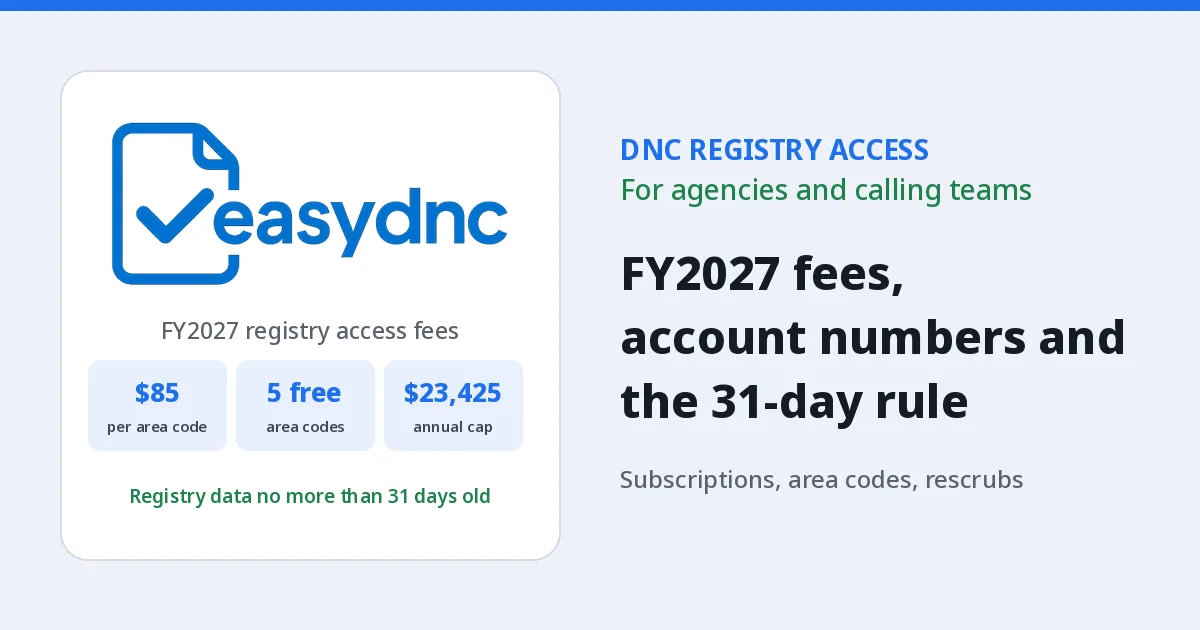
In a final rule published August 26, 2026 (91 FR 54947), the FTC raised the annual fee for each area code of registry data from $82 to $85. The maximum charged to any single entity rose from $22,626 to $23,425. Area codes added during the second six months of a subscription now cost $43 each, up from $41. The new amounts took effect October 1, 2026.
The increase is not discretionary. The Do-Not-Call Registry Fee Extension Act of 2007 ties the fees to the consumer price index, and the FTC reported a 3.5 percent rise since the last adjustment. The fee rule itself, 16 CFR 310.8, still provides the first five area codes at no charge, and it waives the fee for entities that may access the registry but are not required to.
Who Has to Pay, and Why It Matters to Agencies
Section 310.8 makes it a violation for a seller to place, or cause a telemarketer to place, an outbound telemarketing call into an area code unless that seller has first paid for access to that area code's registry data. A parallel paragraph applies the same condition to telemarketers calling on a seller's behalf. The payment can be made "directly or through another person," but the obligation follows the seller.
Each entity that pays, or qualifies for an exemption, receives a unique subscription account number. That account covers the selected area codes for twelve months, starting on the first day of the month in which the fee was paid. Area codes added in the first six months cost the full $85, and those added in the second six months cost $43 for the rest of the period.
The rule also contains a sentence that many multi-client operations overlook: no person may take part in any arrangement to share the cost of registry access, including an arrangement in which a telemarketer or service provider divides those costs among its clients. An agency's own subscription does not stand in for the subscriptions of the sellers it calls for.
How Service Providers Access Data for Clients
Under 310.8(e), access to the registry is limited to telemarketers, sellers, others making or causing calls to consumers, their service providers, and law enforcement agencies. Anyone accessing the data must certify, under penalty of law, that it is used only to comply with the rule or otherwise to prevent calls to registered numbers.
A party that accesses the registry on behalf of sellers must also identify each seller, provide each seller's unique account number, and certify that the sellers will use the data only for compliance. For an agency, this means client onboarding should include collecting the client's subscription account number and the list of area codes it covers before any campaign is loaded. The FTC's National Do Not Call Registry site for telemarketers and sellers is where organizations set up and manage those subscriptions.
The Telemarketing Sales Rule separately bars selling, renting, or using registry-derived lists for any purpose other than compliance or preventing calls to listed numbers. Scrub results should be treated as suppression data, not as a marketing asset.
The 31-Day Freshness Rule
Paying for access is only half of the requirement. The TSR safe harbor in 16 CFR 310.4(b)(3)(iv) expects a process that uses a version of the registry obtained from the Commission no more than 31 days before any call is made, along with records documenting that process. The FCC's rule at 47 CFR 64.1200(c)(2)(i)(D) uses the same 31-day standard for its own safe harbor.
In practice, a list scrubbed in early October and still being dialed in mid-November relies on data that may be too old to support that defense. Numbers are added to the registry continuously, and a long-running campaign can drift out of the window without anyone noticing. A practical habit is to rescrub any active list on a fixed schedule shorter than 31 days, and to rescrub immediately before relaunching a paused campaign.
The safe harbor also lists other elements that a registry scrub cannot supply on its own: written procedures, trained staff, a maintained internal do-not-call list, and monitoring of compliance. Our article on processing do-not-call requests covers the internal list side.
A Year-End Workflow for Teams and Agencies
December is a sensible time to check registry housekeeping before first-quarter campaigns are planned. Many teams expand into new markets in January, and a new area code is easy to add to a dialer but easy to forget in a subscription. A short review covers most of the gaps:
- Confirm each seller's subscription account number, renewal month, and the area codes it covers.
- Compare those area codes against the area codes in every list scheduled for the next quarter.
- Record the date each list was last scrubbed and set a rescrub date inside the 31-day window.
- Suppress internal do-not-call numbers and applicable state lists alongside the federal scrub.
- Keep scrub dates, file names, and results with the campaign records.
Agencies should put these responsibilities in writing with each client: who maintains the subscription, who adds area codes, who runs the scrub, and who keeps the records. When a client's subscription lapses or an area code is missing, the list should be held until the gap is closed rather than dialed on the assumption that someone else has it covered.
Where EasyDNC Fits in the Process
EasyDNC checks numbers against the National Do Not Call Registry through file uploads, a single-number lookup, and a real-time API. Teams can split wireless and landline results, and uploaded files are deleted after the scrubbed list is downloaded, as described in the EasyDNC FAQ. For rescrubbing on a schedule, the API lets a dialer or CRM check numbers at the point they are loaded instead of relying on an export from weeks earlier.
A scrubbing tool does not replace a seller's own obligations under the fee rule, and it does not hold a team's internal do-not-call list. State requirements can add further layers, as our article on Pennsylvania's Act 47 and calling hours shows. Teams with questions about their access arrangements should confirm them with counsel before the next campaign.
Registry Access as Routine Maintenance
The FY2027 fee change is a three-dollar adjustment, but the rules around it carry more weight than the price. Each seller needs its own paid access for the area codes it calls, agencies cannot split one subscription across clients, and scrubs need to rely on registry data no more than 31 days old.
Teams that track subscriptions and area codes per client, rescrub active lists on a fixed schedule, and keep dated records are in a far stronger position than those that treat registry access as a one-time setup. That standard costs little to maintain and holds up as campaigns grow.
This is general information, not legal advice. Registry access, fee, and do-not-call requirements vary by call type, state, and business arrangement, so confirm your obligations with qualified counsel or your compliance team.
This article is general information, not legal advice.